
Truly hurty words
The murder of Ann Widdecombe and the question of incitement


Let’s suppose that the death of Ann Widdecombe was a political murder, in that she was chosen as a victim not just because she was a vulnerable elderly lady living in an isolated but widely identified bungalow, but because she was a well-known political old lady living in an isolated but widely identified bungalow. Might it be true, as her party comrades have insisted, that what drove her killer (we can’t speculate about whether the man charged, Joshua Kerry, is guilty) was an atmosphere of hate towards Reform generated by the press and the party’s opponents?
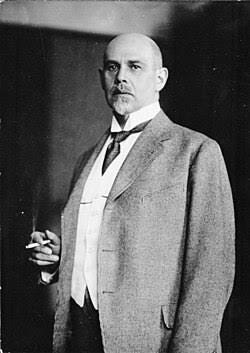
In the early summer I was reading Stefan Zweig’s memoir The World Of Yesterday, an account of his life as a successful writer in the Europe of the first 40 years of the 20th century. Zweig was a secular Austrian Jew, simultaneously an observer of men, and a political naif. He knew and met almost everyone in the literary world and one of his acquaintances, made in the chaotic days of the early Weimar Republic was the industrialist and intellectual, Walther Rathenau.
Zweig describes him as having an intimidating mind, precise, probing and clear. “When you talked to him”, Zweig wrote, “you felt simultaneously stupid, inadequately educated, uncertain and confused in the face of his calm objectivity as he assessed and clearly surveyed the subject of conversation.”
In the early 20s Germany required leaders to negotiate the aftermath of the First World War. They would need to possess an almost ferocious realism as they sought to mitigate the demands placed upon the defeated nation by the often vengeful Allies. It was never likely to be a popular job.
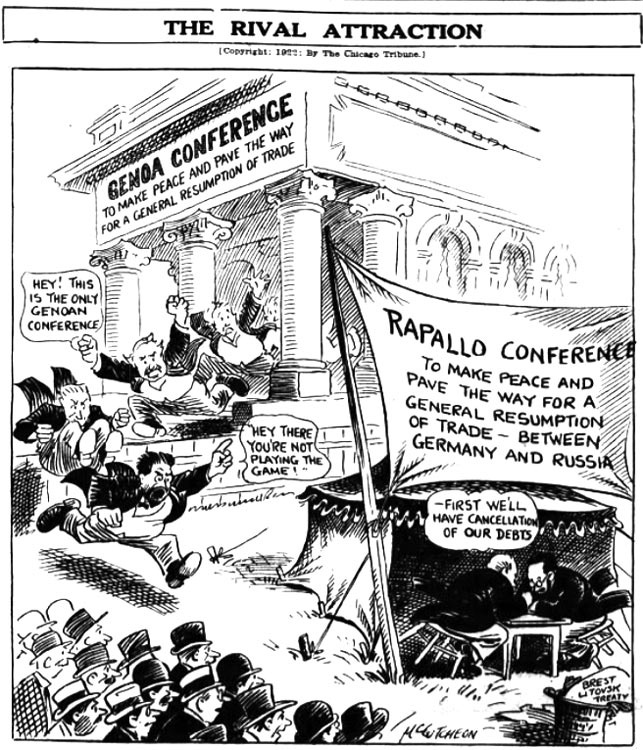
It should have been hard to depict Rathenau as anti-patriotic. During the war he had been an effective organiser of Germany’s industrial war effort and was in charge of the Raw Materials department for the first year of the conflict. The treaty of Rapallo, which he negotiated as foreign minister with the young Soviet Union in 1922 allowed Germany to circumvent the most stringent restrictions placed on its rearmament. But as Zweig recalled, “already certain groups were gaining ground in the country, knowing that they would recruit supporters only if they kept assuring defeated Germany that it had not been defeated after all, and all negotiations and concessions were treasonous.”
Those “certain groups” fed off the dolchstosslegende – the stab-in-the-back theory - spread not least by former military men such as Ludendorff and, from 1919 by Hindenburg (later to become president), had it that the defeat was an inside job. Left to itself Germany’s glorious army would never have succumbed, but treacherous politicians, many of them Jews, had sought to undermine the Reich.
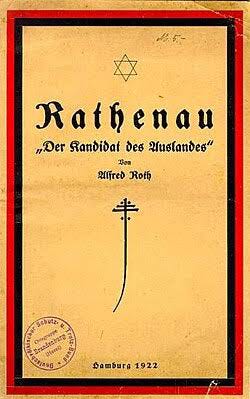
Rapallo was not portrayed by the nationalist right as the clever workaround for Germany that it actually was, but as a continuation of the betrayal at Versailles and part of a Jewish Bolshevik plot. In Rathenau - a wealthy cosmopolitan Jew - the far right groups found a ready scapegoat. Pamphlets such as Alfred Roth’s Rathenau, the Foreigner’s Candidate and Theodor Fritsch’s Anti-Rathenau depicted him as a traitor and part of a Jewish conspiracy.
So venomous was this campaign that among right wing students’ organisations, paramilitaries and veterans’ associations – and even children in the street – a ditty was sung. In German it goes…
Auch Rathenau, der Walther,
erreicht kein hohes Alter.
Knallt ab den Walther Rathenau,
die gottverdammte Judensau.
Which translates as:
Also Walther Rathenau,
Will never reach old age.
Shoot Walther Rathenau,
The god-damned Jewish sow
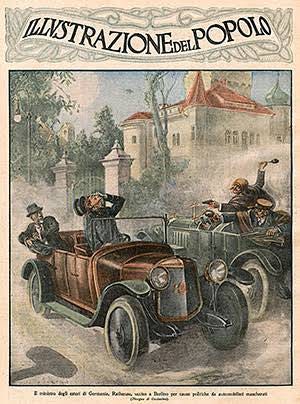
On 23rd June 1922 one of the leaders of the “respectable” nationalist party, the DNVP, Karl Hefferich, made a speech in the Reichstag attacking Rathenau for being anti-patriotic and selling out the interests of the nation. A day later a car carrying two armed men on its back seat came abreast of Rathenau’s open limousine as it drove through a Berlin suburb. One shot at the car with a machine pistol and the other threw a grenade. Rathenau was killed.
The assassins, from highly respectable military and police families were found by police, one dying in a shoot-out and the other taking his own life. They were members of a semi-clandestine ultra-nationalist group most of whose members subsequently joined Hitler’s NSDAP.
Rathenau was not the first parliamentary victim of right-wing assassins. The previous summer another democratic politician associated with the aftermath of Versailles, the Catholic centrist, Mathias Erzberger, out walking with a friend in the Black Forest, had been shot dead by assassins. This followed a campaign of vilification in the nationalist press – a campaign in which one newspaper had observed of the portly Erzberger that “he may be as round as a bullet, but he is not bullet-proof”.
Zweig was recollecting Rathenau’s murder in a book published 20 years later and which appeared in February 1942 after Zweig himself, living in exile in Brazil and despairing of the Second World War’s likely outcome, took his own life, alongside his wife. One of my points here is that though not every political murder represents a big slide down the slope to Nazism and world war, they are very rarely harbingers of anything but ill.
The hurtiest of words
My second is about what some have started to call “hurty words” and the question of incitement. When does mere expression become an invitation to violence? How can you judge what kind of expression is more likely to provoke someone to action?
Most clubs and institutions operate on the basis of restraint. For example, speech in the UK Parliament is governed by a series of conventions concerning what MPs may not say about each other. So one MP may accuse the government of “betraying British national interests” but may not describe the prime minister as a “traitor”. These restrictions (which can be irksome) have a twofold purpose: firstly, to maintain the reputations of “honourable members” as a collective, and second to avoid the kind of language that might inflame passions and conceivably lead to physical confrontation.
In practice the licence which speech gives to brutality tends to attach itself to very specific expressions. The first kind dehumanises the subjects, usually characterising them as somehow contaminating society. The second casts them as betrayers of the community. In the demonology underpinning the Great Replacement conspiracy theory, the two come together with the second group (often Jews) conspiring to flood society with the first (usually non-white).
Infestation
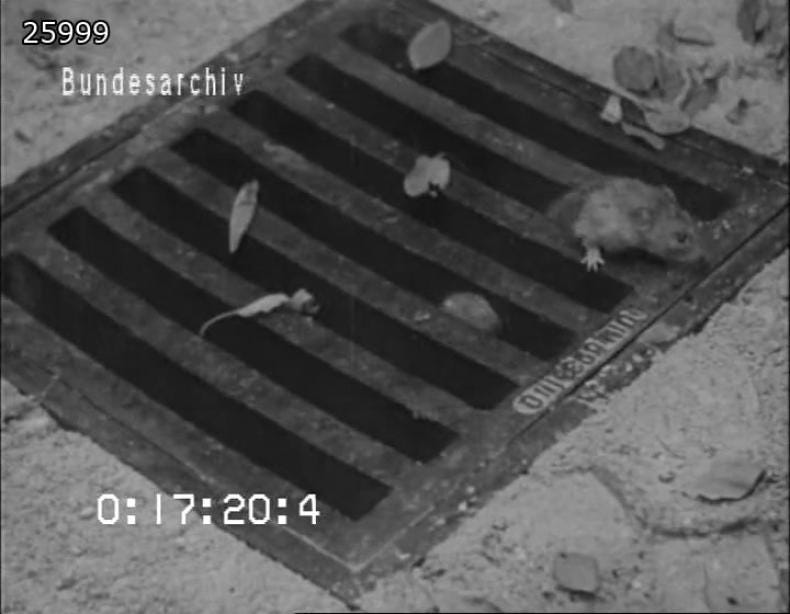
In the 1940 German film The Eternal Jew, footage of identifiably Jewish people was intercut with images of swarming rats. The commentary explained how Jews had “infested” German society and were to be regarded as a pest. This image will have been carried inside the heads of many of those tasked with the mass murder of Jews in the next two years as German armies pushed eastwards.
At the height of the Great Purge in Stalin’s Soviet Union the language used about those being purged was full of terms depicting them as less than human. Andrey Vyshinsky, who acted as prosecutor at several of the great show trials, peppered his description of defendants with terms such as “stinking carrion”, “dirty dogs”, “mad dogs” and “accursed reptiles”. Vyshinsky’s words were carried in all Soviet newspapers and in radio bulletins.
To Pol Pot’s Khmer Rouge anyone suspect, or even inconvenient, was a “microbe” or a “germ” or a “worm”, “burrowing” inside the new society and preventing it from growing healthily. In Rwanda the genocide against the Tutsis was preceded and accompanied by their routine description by the infamous Radio Television Libre des Mille Collines as “inyenzi” or cockroaches. As one broadcast put it, “they are cockroaches... We will squash this infestation.”
