
Oh Mandy
A fatal need to impress

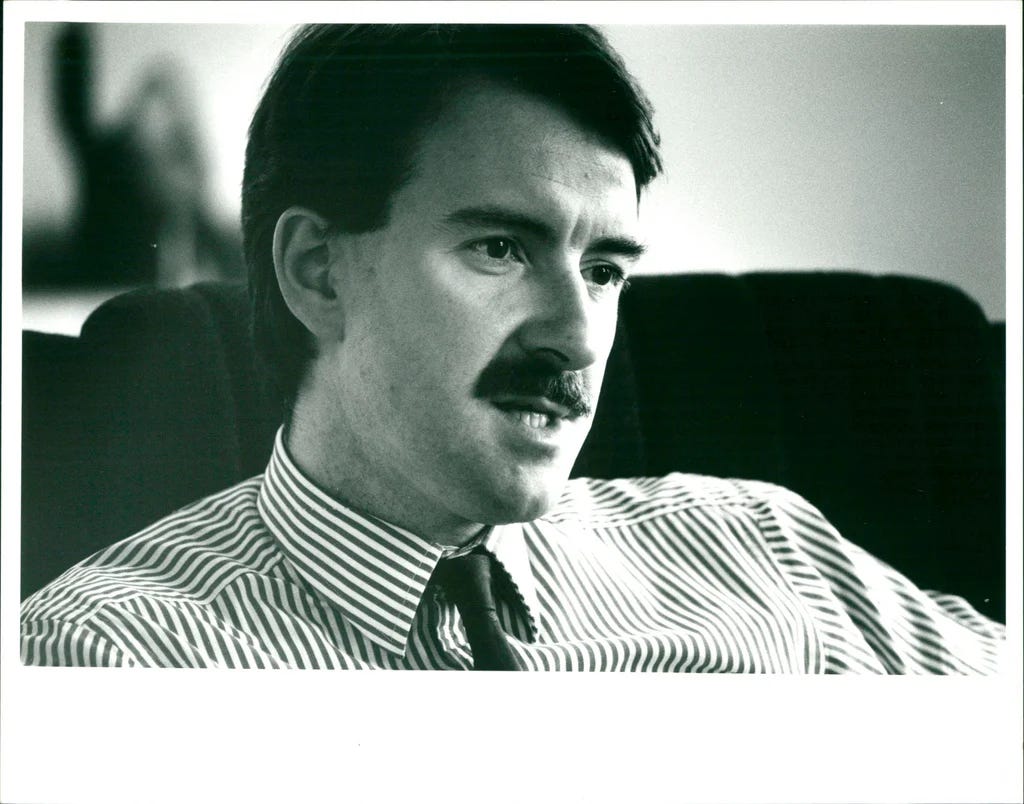
Of those two destroyers of character, money and charm, Peter Mandelson lacked the first, so traded on the second. I put that in the past tense, because there’s no coming back from this week’s revelations about his buttering up his friend, Jeffrey Epstein, with inside information when he was in government.
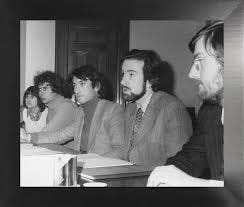
It’s a half century this year since I first met Peter Mandelson. I was a junior member of the National Union of Students executive, and one of the portfolios I was given was to be the NUS representative on the British Youth Council. Wikipedia tells us that the BYC was established by the Foreign Office “to unite young people in Britain against the forces of communism just after World War II”. (This isn’t wrong: the World Federation of Democratic Youth, set up in London in 1945, which developed into a communist front organisation, headquartered in Budapest, was thought to represent an ideological threat. But a series of scandals about CIA funding for rival organisations helped turn outfits like the BYC into more subtle instruments of Western policy, along the lines of show, don’t tell.)
The then chair of the BYC was Peter Mandelson, aged 22, just out of Oxford and representative of something called the Young European Left, which had campaigned for a Yes vote in the 1975 Common Market referendum.
It was the job of Peter and the BYC’s CEO, Tom Shebbeare (later head of the Prince’s Trust), to bind together youth representatives as various as Lady Patience Baden-Powell of the Girl Guides, Tom Bell of the Young Communist League and Eric (now Lord) Pickles, of the Young Conservatives. And to use their combined influence to lobby for youth interests. And he did.
I liked Peter immediately. He had (still has) a wonderful wide grin. He was funny, clever, mischievous and political in a way that was new to me; my politics was still mostly about demonstrations, conferences, solidarity with strikers, liberation movements, while his was about persuasion and manoeuvre. He had Donald Trump’s gift for nicknames that stuck and a talent for gossip. He was the epitome of that saying attributed to Alice Roosevelt Longworth: “If you don’t have anything nice to say about anyone, come and sit next to me”.
If he was charming and mildly malicious, he was also fragile and emotional. He was a gay man in the mid-70s, when the scene was wild (John Rechy’s The Sexual Outlaw was published in 1977, Larry Kramer’s Faggots in 1978), but the stigma was still enough to kill a career in public life. His close friends knew he was gay – his campness was part of his charm and some of his exploits incredibly risky – but to the rest of the world he was a straight guy, complete with a walking-out woman friend for public occasions. In those days he also had a beard.
To say much more about Peter Mandelson’s personal life in the late 70s and early 80s would be to break confidences and upset good friends. He became a Labour councillor in “Red” Ted Knight’s Lambeth. When that route into a political career petered out, and as Labour stumbled towards oblivion under the incorruptible Michael Foot, he joined London Weekend Television (on the same day in 1982 as I did) as a researcher on The London Programme. Our colleagues included Trevor Phillips (at whose first wedding Peter served as best man) and current BBC chair Samir Shah, so LWT’s ability to produce senior TV executives was something wonderful. But it wasn’t what Peter wanted.
The boss’s best friend
It was at LWT that I realised Peter’s capacity for making himself the indispensable friend of whoever was the coming man - he would lovebomb them, make them the centre of all his attention, leaving the last coming man suddenly ghosted. When he was transferred from The London Programme to Weekend World (the current affairs show that I was already working for), within weeks he was the favourite of the programme’s editors. Despite his joviality though, he had a sly capacity for undermining potential rivals, even if they were friends. At the lowest possible level, he even did it to me; if his career was to be in TV journalism, then he would use “politics” to advance it. One Tory producer nicknamed him “snake”, but his politicking was mild, really, and I’ve met far worse people in the business.
By now he was wearing a moustache.
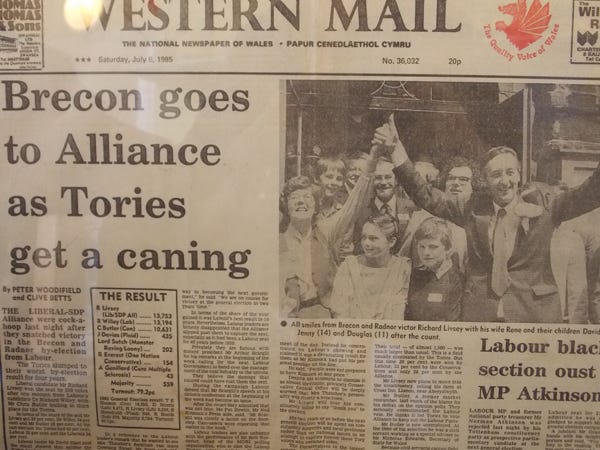
But though we were making our way as journalists, for Peter it was just a lay-by while he was waiting for a political lift. In the 1983 general election Labour had been crushed in the first Thatcher landslide (1979 had been far closer). Neil Kinnock had become Labour leader and in 1985 there was a by-election in the mid-Welsh seat of Brecon and Radnor. Astonishingly (to me) Peter disappeared from the LWT office to organise the campaign of the Labour candidate, who very narrowly lost to the Liberal-SDP Alliance man. He’d done enough. Weeks later Kinnock appointed him as Labour’s director of communications, saying later, “he was very good. I would say that at the time he came out of the top drawer.” (In the same interview in 2010 Knock also said that Mandelson had become a “caricature” of himself.)
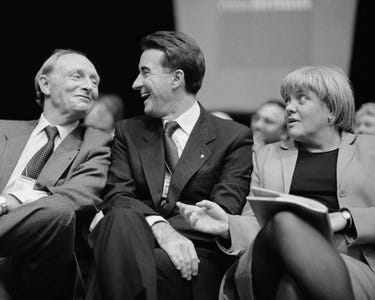
Most of the rest is out there and can be Wiki’ed up:. how when Kinnock stepped down after the 1992 election defeat (Mandelson won his Hartlepool seat in that year) Mandelson became part of the “modernisation” project (I thought it an uncharacteristically ideological role for him), along with Tony Blair and Gordon Brown; how he initially saw Brown as the future of Labour but switched to Blair after the death of John Smith, and how that infuriated the abandoned Brown and his camp. How he was credited by Blair for his role in winning the 1997 election, and how excitable political journalists decided that he was both the true leader of Labour (wrong), the originator of spin politics (wrong again) and the Prince of Darkness (exaggerated, naturally, and linked, I think, to a subtle homophobia).
In short order he was a minister – and a by civil servant accounts - a competent one at that. And in shorter order he was an ex-minister (in the meantime having been “outed” as gay on the BBC by the former MP Matthew Parris). Just before the election he’d managed to get a large interest-free loan to buy a house from the very wealthy Labour MP Geoffrey Robinson, who succeeded Robert Maxwell as the sugar daddy of the Labour Right. In office he had failed to inform the senior civil servant in his department about the loan, hadn’t declared it in the register of MPs’ interests, and had been business secretary when Robinson’s business affairs were being investigated. By Trumpian standards it was a nothing. But New Labour was rhetorically committed to being cleaner than clean, and Mandelson had to resign.
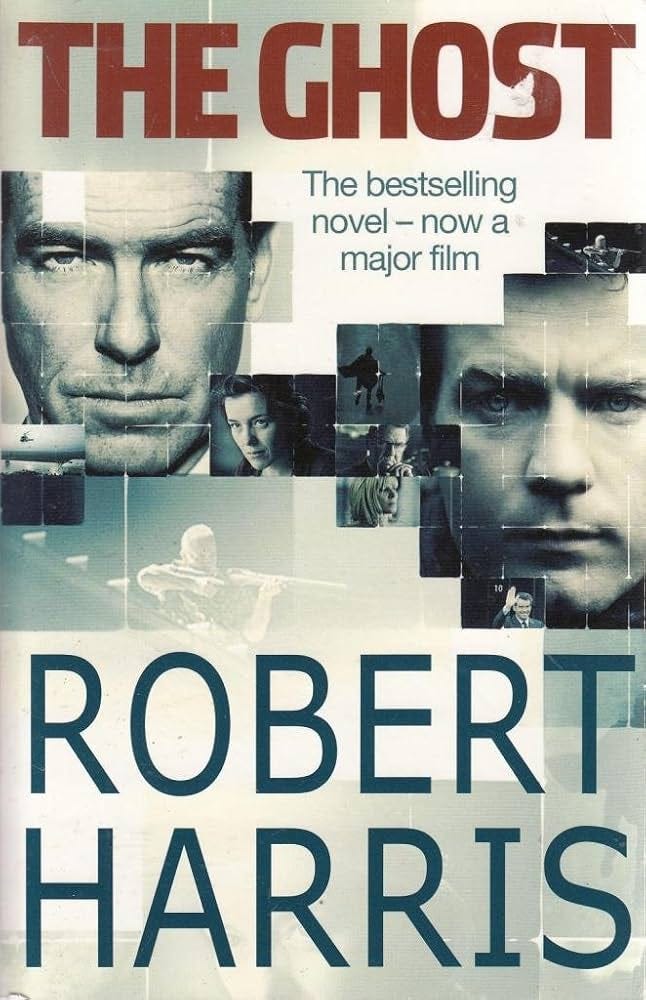
Then, when after a decent interval he was allowed back into the cabinet and was minister for the Millennium Dome, he made a phone call to the Home Office about the progress of passport applications for two major donors to the Dome. There was a mix-up between Mandelson, No 10 and various departments which resulted in Blair’s director of communications, Alastair Campbell, inadvertently misleading journalists. Despite a subsequent report clearing Mandelson of wrongdoing, he was forced to resign again. It’s common knowledge that he felt betrayed. I always thought that his good friend Robert Harris’s 2007 novel, The Ghost, in which the twin villains are a Blair-like ex-PM and his wife, was Peter’s revenge by proxy.

Who wants to journey on a gigantic yacht?
Do I want a yacht? Oh, how I do not!
In the summer of 2008, on Corfu, the family looked out to sea from where we were staying and saw two huge yachts at anchor. One, it turned out, belonged to Rupert Murdoch and the other to the Russian oligarch Oleg Deripaska. I wondered what kind of people would be on board such a weird vessel – a floating prison-palace with its flunkeys and ostentation.
